PortCommand
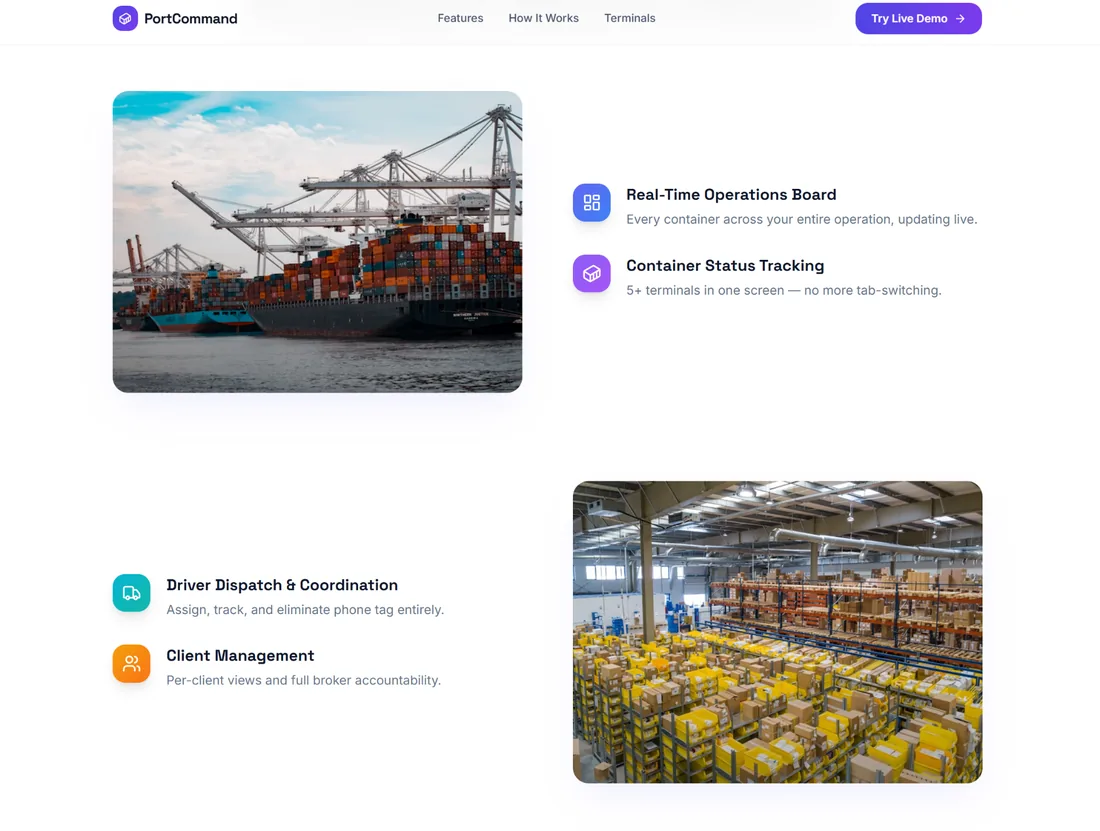
A single web-based command center for NY/NJ container operations with real-time container tracking, driver dispatch, client-linked records and a full audit trail.
The Challenge
Port ops teams were running multi-million-dollar container flows out of shared spreadsheets, group texts and phone calls. Drivers showed up at the wrong terminal. Status checks meant calling the yard.
Every team had its own version of the truth, and any audit question — 'where was this container last Tuesday?' — was a forensic exercise.
Our Solution
PortCommand is a single web-based command center for the entire NY/NJ container operation. Containers, drivers, clients and terminals all live in one place, with a real-time view that the dispatcher, the driver and the client all share.
Every state change is audit-logged, so the answer to 'where was this container last Tuesday?' is one click instead of one afternoon.
What We Built
- Real-time container tracking across NY/NJ terminals.
- Driver dispatch coordination with mobile-friendly assignments.
- Client-linked records — every container tied to the right account, the right invoice and the right contact.
- Terminal-specific status checking that surfaces the right info per terminal.
- Full audit trail for every container, dispatch and status change.
How We Delivered
Discovery
We sat with the team using the current tools and watched where work actually broke down.
Design
Wireframes and clickable prototypes the client could test before a single line of production code.
Build
Iterative releases with weekly reviews so the product stayed honest to real workflows.
Launch & Support
Migration, training and an ongoing improvement loop after go-live.
Results & Value Delivered
One source of truth
Dispatchers, drivers and clients now read from the same live data instead of three stale spreadsheets.
Fewer wrong-terminal trips
Status checks happen in the app before the truck rolls, not after.
Audit-ready
Container history is exportable per client, per date range, per terminal.
Capabilities Used
More from our portfolio
Want something like this?
Tell us what you're trying to ship. We'll come back with a plan, a timeline, and a number within 24 hours.
Start a conversation